

Glossary
All hobbies and interests have terminology to describe elements of the hobby, and irises are no different. Colours, patterns, growth habit and parts of the plant all have names which are useful to know. Below is a list of terms we use.
Parts of the iris plant
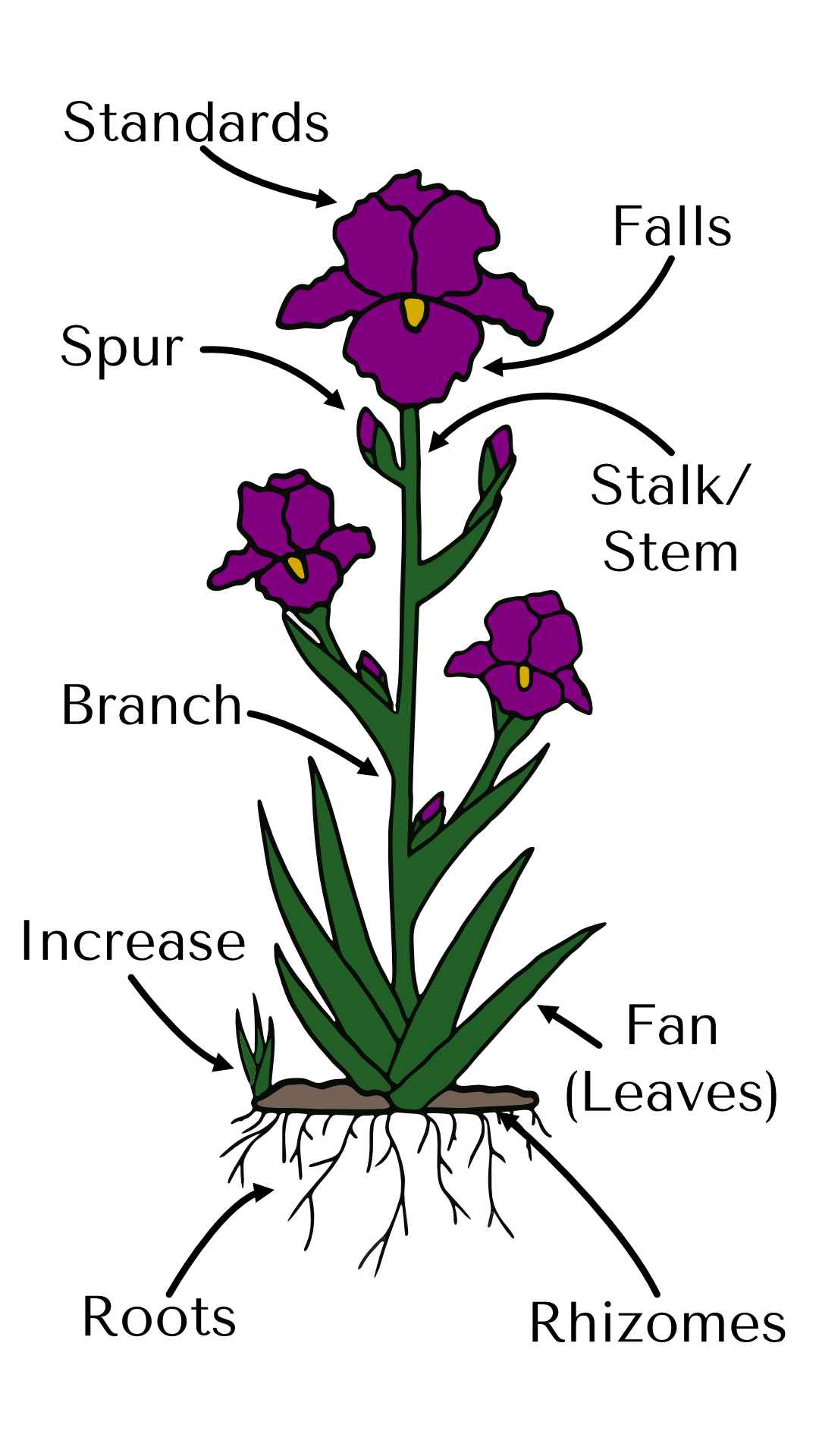
Rhizome: The fleshy, dark brown horizontal tuber from which the roots and leaves grow. It also sends out new rhizomes for future flowers.
Increase: New rhizome and leaves emerging from the side of the original rhizome, which make a new plant.
Fan: A set of leaves growing from the rhizomes, fan-like in shape.
Stalk (stem): Flower stalk, which may have branches coming from it to give additional flowers.
Branch: A branch off the main stem. There may be several branches on one stem.
PBF: Purple-based foliage. The base of the leaves may have a purple colour changing to green a little way up.
Variegated: Foliage is broken green and white or green and yellow in colour.
Spathe: Modified leaves that cover the emerging buds usually become brown and papery.
Spur: A short branch on the stem below the terminal flower.
Parts of the iris flower
Standards: The three upright petals that surround the three style arms.
Falls: The three lower petals, which can be downturned (hanging) or horizontal.
Beards: Furry caterpillar-like growth on top of the falls.
Space Age (SA): Varieties of iris that have extensions to the beards in way of horns, flounces, spoons or pom poms.
Signal: A patch of contrasting colour surrounding the beard, emanating from the throat of the flower.
Horn: A pointed appendage extending from the end of a beard.
Flounce: A petal-like appendage that extends from the end of a beard.
Spoon: A spoon-shaped appendage that extends from the end of a beard.
Pompom: A pompom-shaped appendage that extends from the end of a beard.
Style Arms: three upright crested structures behind the standards, which are part of the reproductive system. Each style arm has a stigmatic lip where the pollen sticks to pollinate the flower.
Form: shape, balance and proportions of the flower.
Substance: The strength and thickness of the petals. Prevents flowers from collapsing due to wind and rain.
Texture: The finish or sheen on the petals.
Midrib: The stiffened central rib on each standard.
Hafts: The upper parts of the falls, on each side of the beard.
Shoulders: The areas on the arched middle parts of the falls, outwards from the hafts.
Ruffles: fluted or wavy petal edges. Can vary in the number of waves.
Lace: Serration on the outer edge of the petals.
Colours and Patterns
Through hybridising work over many years, the iris is now available in so many colours and patterns. In fact, there are all colours except true red and true green, although some are very close. There are many forms of patterning and new ones emerging quite regularly.
Self: A flower with all petals of one solid colour.
Amoena: White or near white standards and coloured falls.
Reverse Amoena: A flower that has coloured standards and white or near-white falls.
Bicolour: Standards and falls are two different colours.
BI tone: The standards are of a lighter tint of the colour of the falls.
Reverse BI tone: Standards are a darker shade of the same colour as the falls.
Neglecta: Light blue or purple standards with falls of a darker shade of the standards.
Variegata: Yellow or near yellow standards with darker coloured falls, usually red, purple or brown.
Plicata: Flowers that have a light base colour with stippled, spotted, or stitched markings in a darker or different colour.
Glaciata: Flowers lacking the purple anthocyanin pigment, giving a bright, glowing white, yellow, pink or orange.
Luninata: White or yellow base colour of a petal washed over with a darker colour. Style arms and hafts are white or yellow. There can be pale veining and usually pale edges to petals, so it appears to glow from within.
Blend: A combination of two or more colours blended together.
Broken colour: A random splotchy or streaky pattern of colours.
Spot: A contrasting patch of colour on the falls, which may cover most of the falls. Can be a regular feature in dwarfs.
Ground colour: Base colour of a petal under the dots, lines or peppering. Usually applies to Plicatas.
Lines or lined: Veins that are of a contrasting and/or darker colour to the base colour of the petal.
Peppering: Spotted or stippled markings contrasting with a lighter base colour on petals. As in plicata’s.
Rim: A thin edge of colour around the petals.
Wire edge: An extremely thin edge of colour around the edge of a petal.
Bearded Iris Bloom Season.
It is often said that bearded irises have a very short bloom season. This isn’t entirely true. Yes, a single plant may be short-lived, but usually due to a poor season and poor weather conditions. Some years, a plant may be in bloom for weeks. If we look at the daffodil, A flower most gardeners would always have, individual plants don’t last too long, but succession planting makes their season longer. Starting with smaller early varieties, then main season types and finishing with something like the pheasant eye narcissus, their season lasts for a couple of months. The same is for bearded iris; succession planting gives a very long bloom season. Starting with dwarf varieties, then moving to Intermediates and on to Tall bearded, border and miniature tall bearded, the season can last from mid-April to the end of June, sometimes even longer.
When looking to buy bearded iris, it is always worth looking at their bloom period. Very often, they are marked with abbreviations to show the bloom season.
VE: Very Early bloom season.
E: Early bloom season.
EM: Early to midseason bloom season.
EML: Early-mid-late season blooms.
ML: Mid to late season bloom.
L: Late season bloom.
VL: Very late bloom season.
RE: Irises marked as RE can, in the right conditions, rebloom in late summer/early autumn.