

Choosing the Right Iris for Your Location
Height is an important factor in choosing any plant. Usually shorter plants get placed at the front of a border, while tall plants get placed at the back. Taller plants could also be placed somewhere in the middle to add some variety. As our climate changes, wetter weather and increased periods of high winds is also becoming a factor in how tall we want our plants to be.
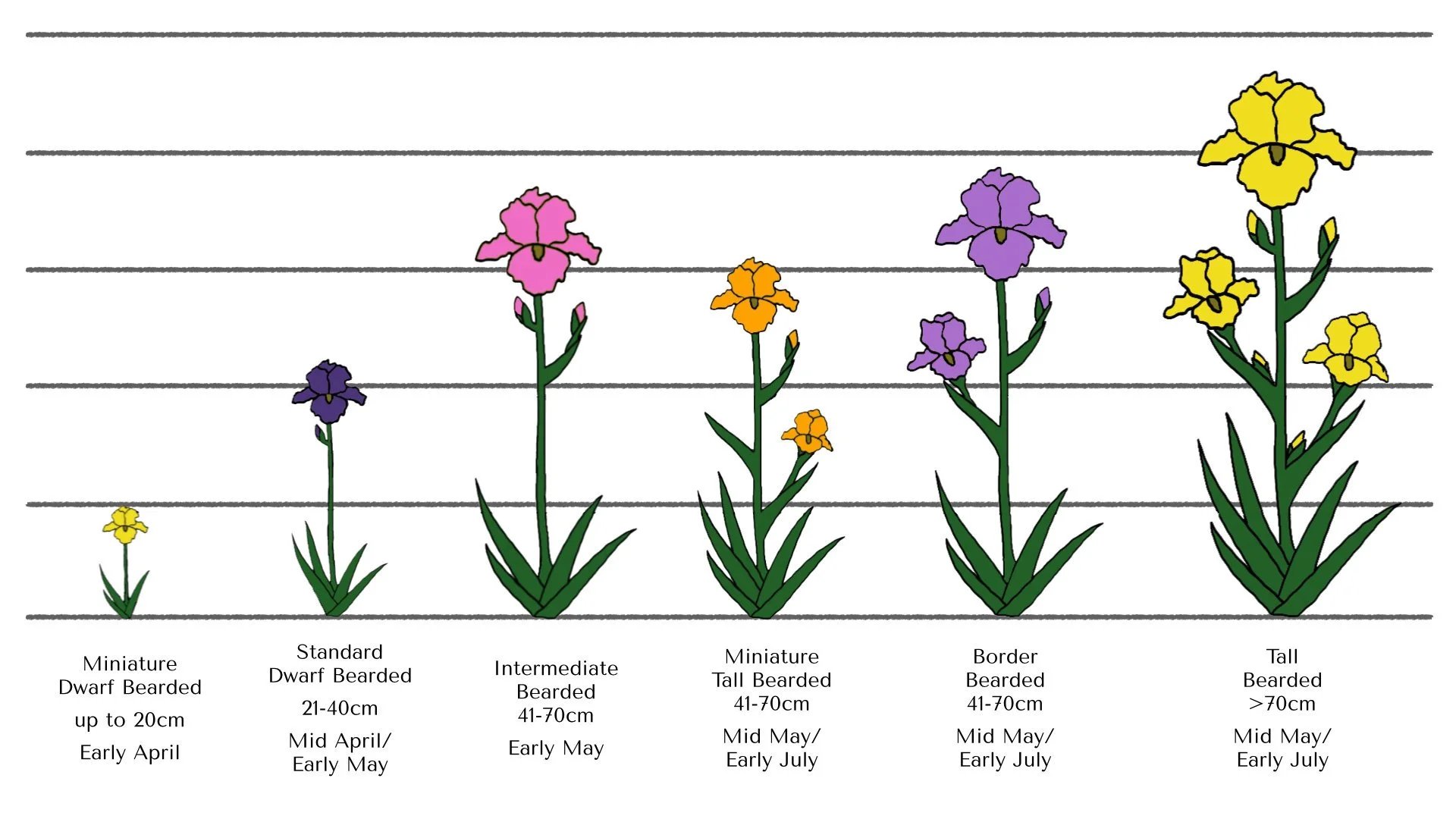
The bearded iris has an exceptional variety in heights. Some of the species may grow to less than 10cm in the wild, in order to adapt to their location. Others, such as tall bearded iris, can grow to over 120cm. As long as you have a well-drained, sunny location, there’s a bearded iris that’s the right height for most planting schemes.
For those with alpine greenhouses, troughs, or gravel gardens, miniature dwarf bearded iris and some standard dwarf bearded iris are ideal. They expand into good sized plants which can put on a real show in early spring. Miniature tall bearded iris can also be useful in a gravel garden with their delicate blooms on wiry stems. Starting at 40cm, they can add a little height to the planting scheme, while also extending the flowering period.
Standard dwarf bearded iris have a height range of 20-40cm and are ideal for the front of a bed or border, making good sized plants full of flowers. Blooming from April to May, they can be really useful in keeping the garden vibrant throughout the flowering season.
Tall bearded iris make a real statement in any garden. Starting at 70cm, they can be combined with other late spring or early summer plants, such as lupins, alliums, aquilegias and early clematis, to make a beautiful picture. Taller varieties can occasionally suffer damage in areas with high winds and very wet weather. Nevertheless, they make a valuable addition to any garden.
In areas where wind and rain is a problem, there are other options. Border bearded iris are similar to tall bearded iris, flowering at the same time, but are a bit shorter. Standing between 40-70cm, the border bearded iris’ shorter stature helps to reduce any damage that might be caused by the wind. Their flowers are also smaller, making their proportions similar to tall bearded iris, meaning that they collect less water in wetter weather, and so aren’t weighed down rain. Their reduced height is also ideal where reduced planting heights are needed.
Another bearded iris that deals with windier weather well is the miniature tall bearded iris. With small delicate flowers on wiry stems ranging from 40-70cm, they can be surprisingly resilient. Their wiry stems allow them to flex in high winds, rather than breaking, and their smaller flowers are weighed down less in wet weather. With plenty of flowers, these are ideal for any area of the garden.